
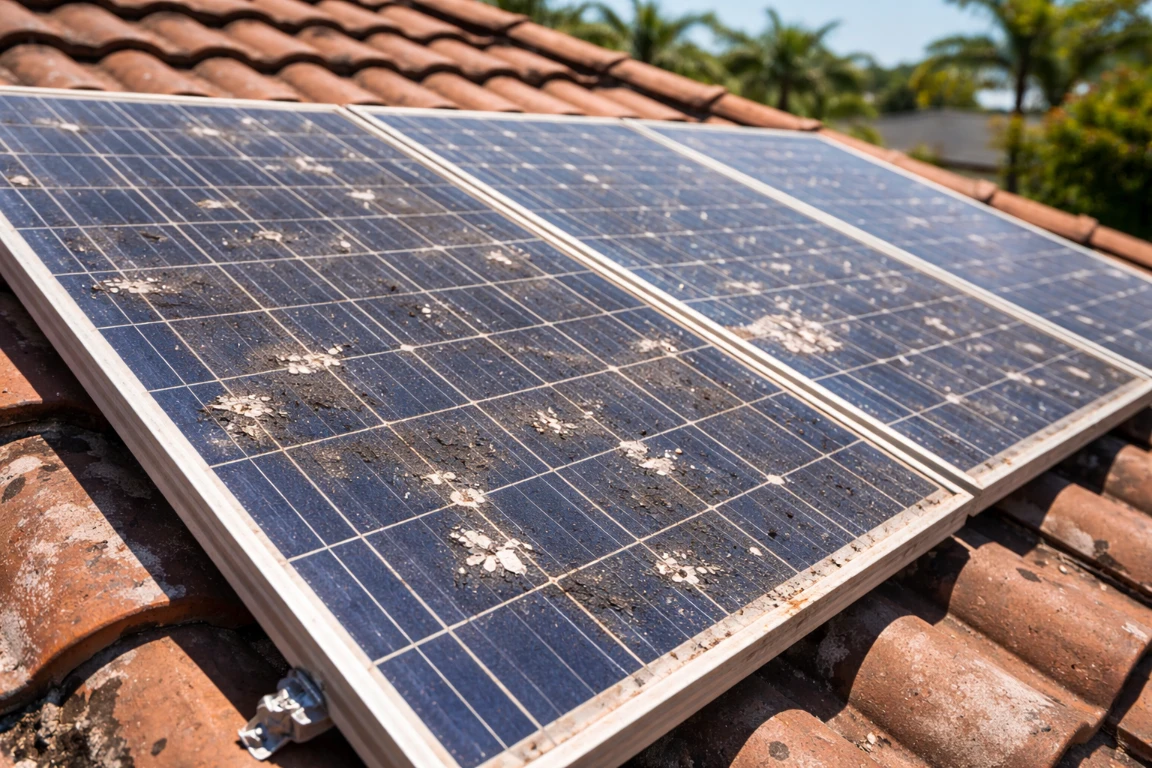
For many Queensland homeowners, installing solar was a major step towards energy independence and lowering the cost of living. We live in the “Sunshine State,” after all, and our roofs are prime real estate for harvesting free energy. However, once those panels are on the roof, they are often forgotten. This “set and forget” mentality is a costly mistake.
Dirty solar panels are a silent drain on your financial returns. While you might assume that a bit of Brisbane dust or a light coastal breeze will keep things tidy, the reality is that environmental pollutants create a persistent film over the glass that blocks sunlight and throttles your system’s performance.
In this comprehensive guide, we will explore the science of solar efficiency, why professional maintenance is non-negotiable, and how keeping your panels clean is the fastest way to maximise your energy savings.
The Science of Solar Loss: What is “Soiling”?
In the solar industry, the accumulation of dirt, dust, and organic matter on the surface of a panel is known as “soiling.” It might seem like a minor aesthetic issue, but soiling has a direct, measurable impact on the photovoltaic (PV) process.
Understanding the Photon Barrier
Solar panels work by allowing photons (light particles) to knock electrons free from atoms, generating a flow of electricity. When you have dirty solar panels, you are essentially placing a physical barrier between the photons and the silicon cells. Even a thin, uniform layer of fine dust can reduce the amount of light reaching the cells by 10% to 15%.
The Problem of “Partial Shading”
Soiling is rarely uniform. Bird droppings, clumps of lichen, or piles of leaf litter from overhanging trees cause “partial shading.” This is actually more dangerous than a uniform layer of dust. Modern panels are wired in strings; when one part of the panel is blocked by debris, it creates resistance. This can lead to “hot spots,” where the blocked cells overheat, potentially causing permanent damage to the internal circuitry of the panel.
Common Culprits Behind Dirty Solar Panels in Queensland
Depending on where you live in North Brisbane, Moreton Bay, or the Sunshine Coast, your panels face different environmental enemies.
- Coastal Salt Spray: If you live in areas like Deagon or Sandgate, salt air is your biggest challenge. Salt leaves a sticky, crusty residue on the glass that attracts dust like a magnet.
- Industrial Soot and Road Dust: Properties near major arterials like the Gympie Arterial Road or the Bruce Highway experience heavy deposits of fine carbon soot and rubber particles.
- Bird Droppings: Birds love the warmth of solar panels. Their droppings are highly acidic and opaque. If not removed, they can etch the glass surface and completely block energy production in those specific spots.
- Tannins and Organic Matter: In leafy suburbs like Bridgeman Downs or Everton Park, falling leaves and pollen create a sticky film. When rain hits this debris, it leaches tannins that “tea-stain” the panels.
Why “Letting the Rain Wash Them” is a Myth
One of the most common pieces of misinformation is that a good Queensland downpour will clean your panels for free. Unfortunately, the opposite is often true.
Think of your car windscreen. Does a quick rain shower leave it sparkling? Usually, it leaves it streaky. Rainwater carries atmospheric dust and pollution. As the water evaporates off the hot solar glass, it leaves behind mineral deposits and a muddy residue. Over time, this creates a “cementing” effect where the dirt becomes baked onto the glass by the intense UV rays. To truly restore efficiency, the bond between the grime and the glass must be broken with professional equipment.
The Financial Impact: Counting the Cost of Neglect
If your 6.6kW system is underperforming by just 20% due to dirty solar panels, you are losing roughly 2-3 kilowatt-hours of production every single day. Over a year, that is nearly 1,000 units of electricity you have to buy back from the grid at retail prices.
Professional solar panel cleaning often pays for itself within the first few months through increased energy production.
The Importance of Professional Exterior Care
Maintaining your solar panels shouldn’t be a standalone task. It is part of a holistic approach to home maintenance. For example, if your roof is covered in lichen and moss, those spores will inevitably wash down and settle on your panels. This is why we recommend bundling solar care with a full roof cleaning service.
Furthermore, if you are already having property maintenance services performed, such as a soft-wash house wash or gutter cleaning, adding solar panel cleaning is a cost-effective way to ensure your entire property is running at peak performance.
How Professional Solar Cleaning Differs from DIY
It is tempting to grab a garden hose and a kitchen mop, but this often leads to damage that voids your warranty.
1. The Water Quality Factor
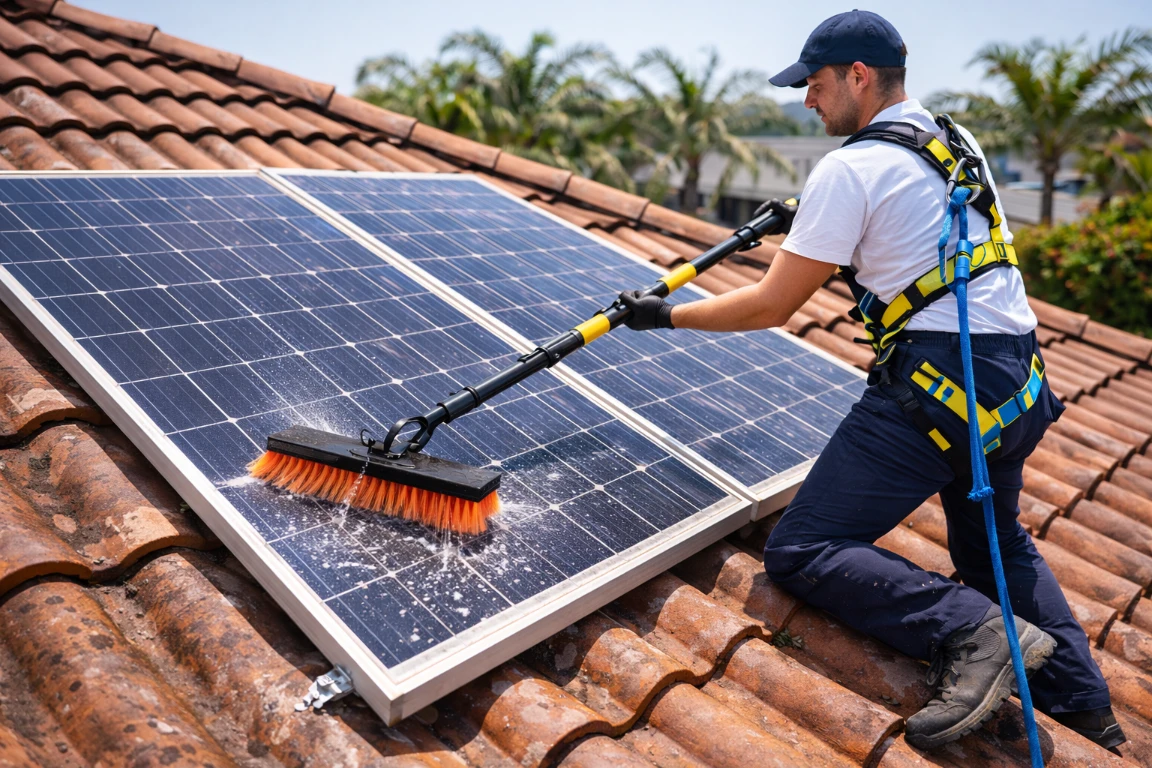
Standard tap water in many parts of Brisbane contains minerals like calcium and magnesium. When this water dries on your panels, it leaves behind “hard water spots.” Professional cleaners use de-ionised or purified water systems that leave a completely streak-free finish, allowing every possible photon to reach the cells.
2. Specialised Equipment
We use soft-bristled brushes specifically designed for solar glass. Using abrasive sponges or harsh household chemicals can micro-scratch the anti-reflective coating on your panels, permanently reducing their ability to capture light.
3. Height Safety
Most solar arrays are located on the highest, most sun-exposed parts of the roof. Dragging a hose up a ladder is incredibly dangerous. Professional teams are trained in height safety and use the correct harnesses and equipment to ensure the job is done without risk to the operator or your roof tiles.
Helpful Maintenance Schedule for Queenslanders
To keep your savings high, we recommend the following schedule:
- Urban/Suburban Areas: Professional cleaning every 12 months.
- Coastal/Industrial Areas: Professional cleaning every 6 months to combat salt and soot build-up.
- Heavy Vegetation: Monitor monthly and clear leaf litter as needed, with a professional deep clean every 6-12 months.